12 Small Kitchen Drawer Organization Ideas You Can Measure Before Buying

Explore the ideas
- 1. Measure below the drawer's top edge
- 2. Keep everyday cutlery in one working zone
- 3. Give long utensils their own lane
- 4. Turn small tools into a shallow group
- 5. Try a sliding top tray only with clearance
- 6. Keep a foil-and-wrap lane easy to lift
- 7. Make lunch-packing tools one small kit
- 8. Reserve space for measuring tools
- 9. Give tea supplies a dry compartment
- 10. Use a separate place for sharp edges
- 11. Leave a spare lane instead of filling it
- 12. Check the drawer while closing it
- Buy around the problem you actually found
The drawer can look large enough until the organizer catches beneath the counter. Small kitchen drawer organization starts with the usable opening and the things that move through it. A tray’s outside dimensions don’t tell you whether the drawer will close around its contents.
Empty one drawer and choose the everyday job it needs to perform. Keep the items used together in view before deciding how many compartments to create. The goal is finding and returning tools comfortably, rather than making every available gap hold something.
These concepts include existing trays and dividers as well as possible storage alternatives. Check the exact version and its current dimensions before ordering a replacement. A layout photograph illustrates the arrangement; it doesn’t establish a measured fit inside your particular cabinet.
1. Measure below the drawer's top edge
Measure the usable width, depth and closing clearance rather than only the visible front. Check for screws, runners or other fittings that reduce the interior space. Include anything projecting upward from the contents, such as a utensil handle resting at an angle.
Comparable options, not the exact pictured items. Check the selected color, size and buying notes.
Materials, fit and differences from the concept
- Stanley PowerLock tape measure: Sixteen-foot retractable tape measure. Check usable internal space, not just advertised external bag or cabinet dimensions.
Open and close the empty drawer while noticing which parts move past each other. Frame-supported organizers need a different fit check from those resting on the bottom. Keep those two support arrangements separate when comparing products.
2. Keep everyday cutlery in one working zone
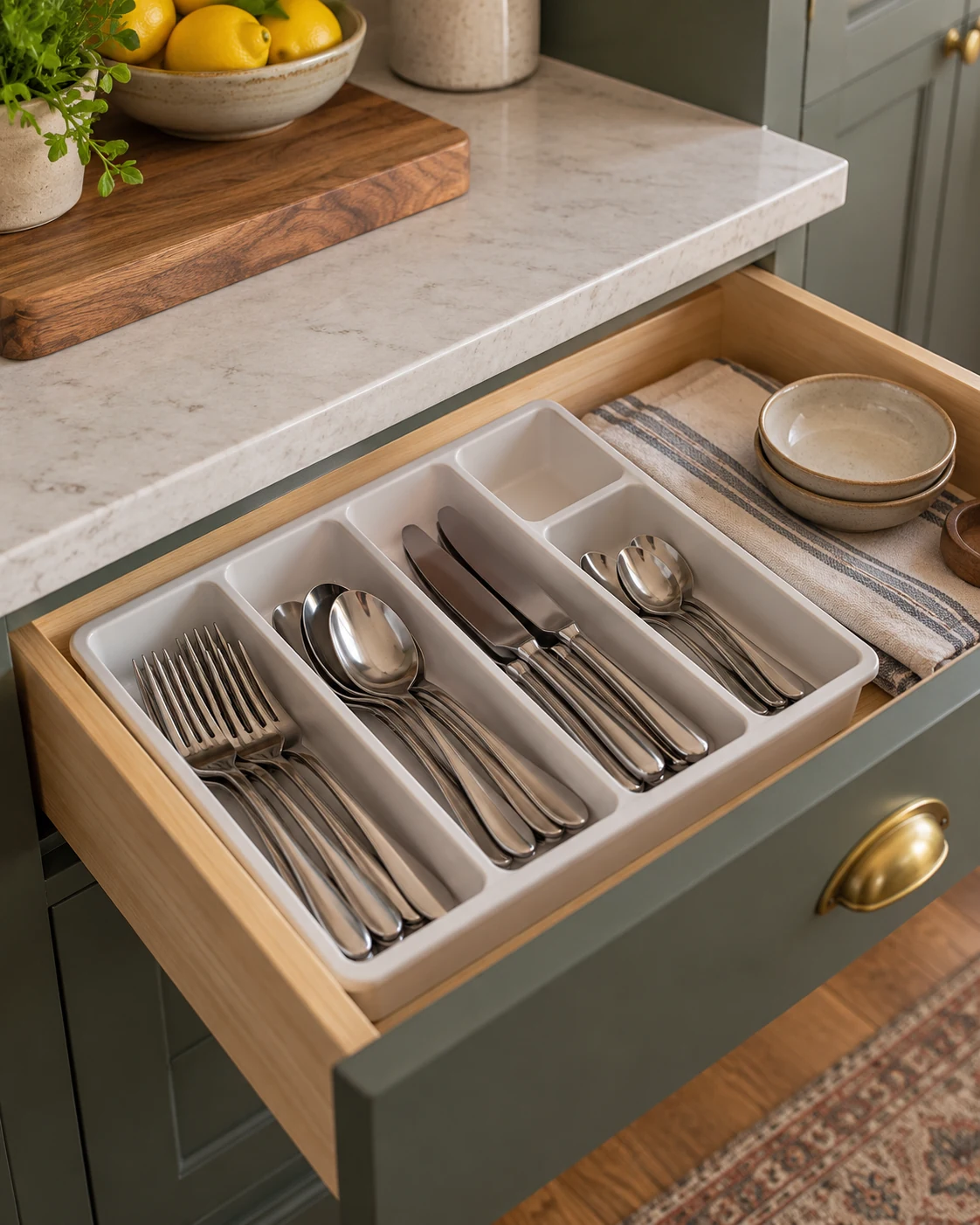
Put ordinary forks, spoons and table knives where you reach for them most often. An existing low tray may already provide the separation needed. Check that you can lift one item without catching neighboring handles or digging beneath a pile.
Comparable options, not the exact pictured items. Check the selected color, size and buying notes.
Materials, fit and differences from the concept
- Natural bamboo expandable cutlery tray: ROYAL CRAFT WOOD natural bamboo nine-slot expandable tray. A bamboo alternative to the pictured white or clear trays. Merchant describes 17 x 13 to 17 x 19.6 inches with 1.9-inch slots; maker specs also list 17.5 x 13.5 x 2.5 inches. Confirm exact outside dimensions and closing clearance. Some buyers report the expandable parts move; no locking or universal-fit guarantee.
Choose the amount around the household’s usual use rather than the maximum the compartment can hold. Store occasional extras elsewhere when they crowd the everyday group. Keep sharp preparation knives appropriately protected in their own suitable storage, outside the loose cutlery arrangement.
3. Give long utensils their own lane

Place the longest utensil inside the proposed lane before choosing its boundaries. Include the head’s width and the space needed to lift the handle. A lane fitted around a narrow spoon may be too small for a wider spatula.
Comparable options, not the exact pictured items. Check the selected color, size and buying notes.
Materials, fit and differences from the concept
- Natural bamboo adjustable drawer dividers: ROYAL CRAFT WOOD four-pack, natural bamboo, selected Large version. Title says 17–22 inches, while detailed text gives differing 17–21 or 21.5-inch ranges and depth values. Confirm exact size, depth and spring pressure with the seller before buying. Buyer reports differ on whether dividers shift during use. Separate straight dividers, not a complete fitted box system.
Reuse suitable existing dividers when their fit and condition work. Don’t force a pressure-fit product into a drawer outside its supported range. Leave the utensils easy to return without needing a specific stacked order after every meal.
4. Turn small tools into a shallow group
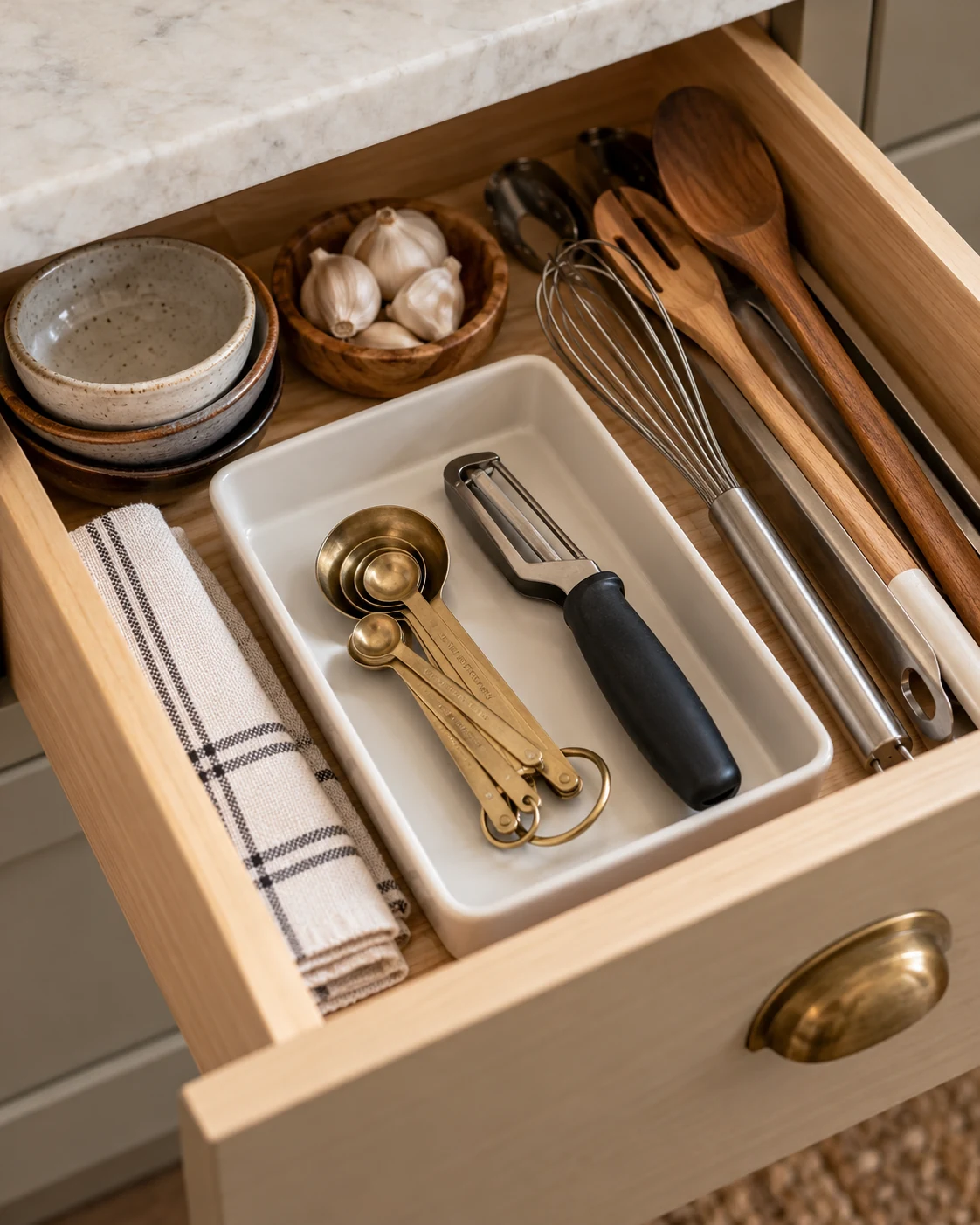
Choose the smaller tools you regularly use together and give them one low container. Check its height beneath the actual closing space, including any handles or lid. A handled bin may fit the footprint yet remain too tall for a shallow drawer.
Comparable options, not the exact pictured items. Check the selected color, size and buying notes.
Materials, fit and differences from the concept
- mDesign clear handled storage bin: Handled clear organizer, 14-inch length. Confirm all dimensions, cabinet opening and care instructions before ordering.
Try an existing suitable container before ordering another set. Keep the group small enough that you can recognize its contents from above. A peeler shouldn’t disappear beneath unrelated gadgets merely because the box has spare capacity.
5. Try a sliding top tray only with clearance
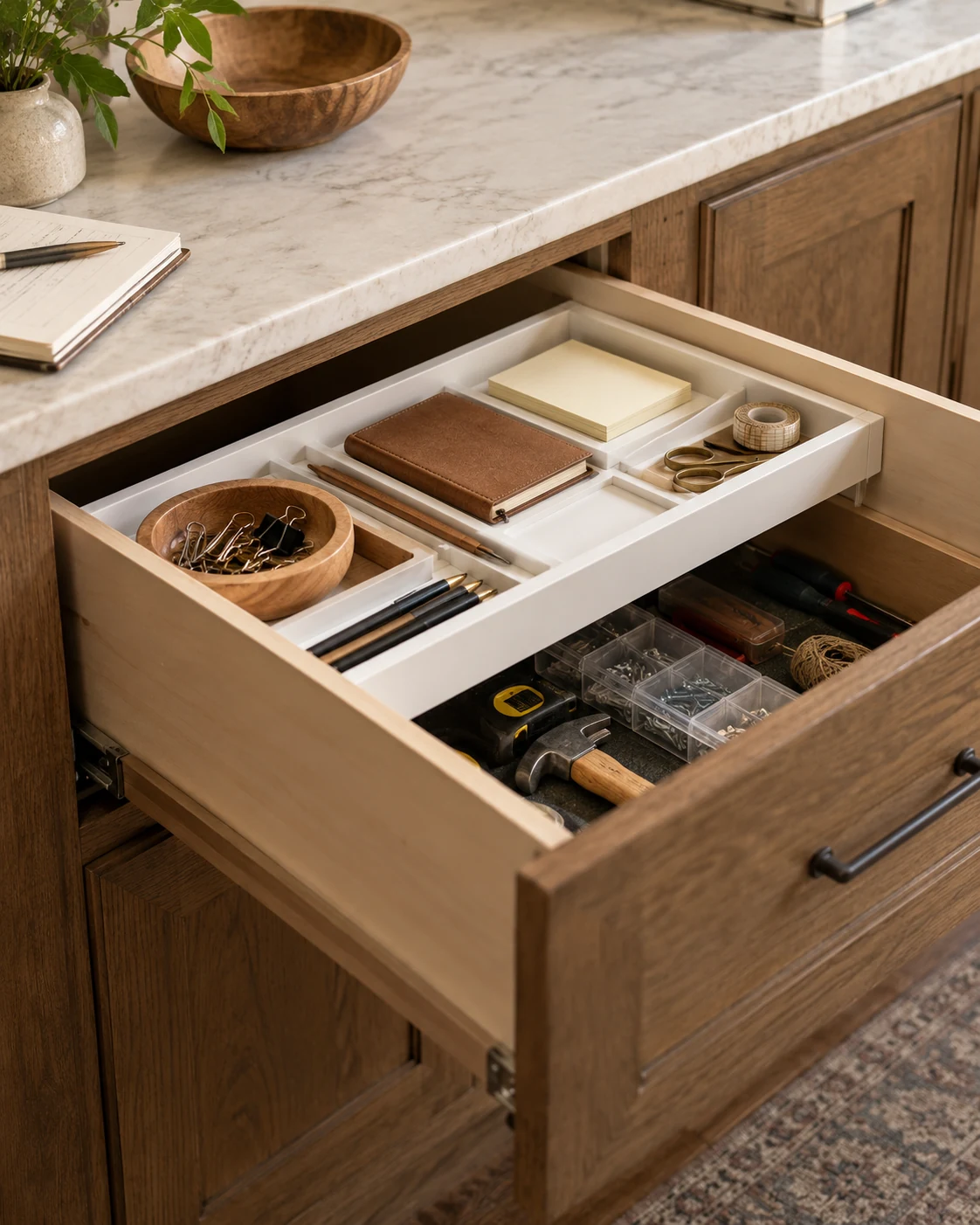
A tray resting on the drawer frame can use space above shorter items. Check its support tabs, extension direction and the clearance above and below. Leave room for sliding without collisions with neighboring contents or cabinet parts.
Comparable options, not the exact pictured items. Check the selected color, size and buying notes.
Materials, fit and differences from the concept
- YouCopia DrawerFit sliding tray: YouCopia DrawerFit sliding tray. Amazon and current manufacturer pages list different heights and extension ranges. Confirm the exact version, supports and required clearance with the seller before buying; no guaranteed dimensions are claimed here.
The linked sliding tray has differing dimensions across the current maker and merchant descriptions. Confirm the exact version with the seller instead of relying on a universal-fit promise. An existing simpler tray may remain the better choice when that clearance isn’t available.
6. Keep a foil-and-wrap lane easy to lift
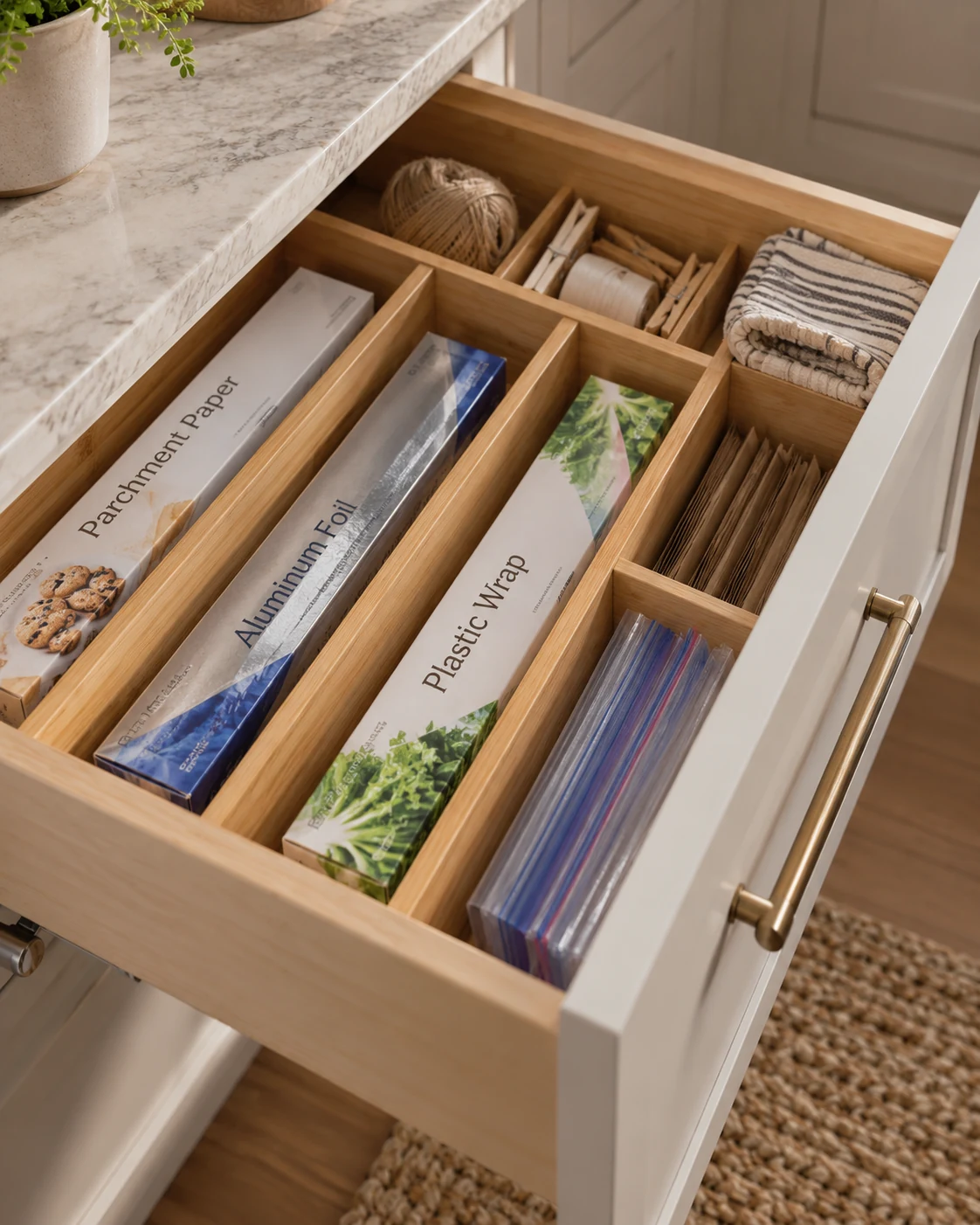
Keep the original boxes together where their labels remain easy to identify. Measure the longest box before placing a divider beside it. You should be able to lift one box without removing its neighbors first.
Comparable options, not the exact pictured items. Check the selected color, size and buying notes.
Materials, fit and differences from the concept
- Natural bamboo adjustable drawer dividers: ROYAL CRAFT WOOD four-pack, natural bamboo, selected Large version. Title says 17–22 inches, while detailed text gives differing 17–21 or 21.5-inch ranges and depth values. Confirm exact size, depth and spring pressure with the seller before buying. Buyer reports differ on whether dividers shift during use. Separate straight dividers, not a complete fitted box system.
Check the box’s cutting edge and keep the packaging in appropriate condition. Don’t move exposed cutting parts into an improvised organizer for appearance alone. A straightforward lane can solve access without adding a new dispensing system to the drawer.
7. Make lunch-packing tools one small kit
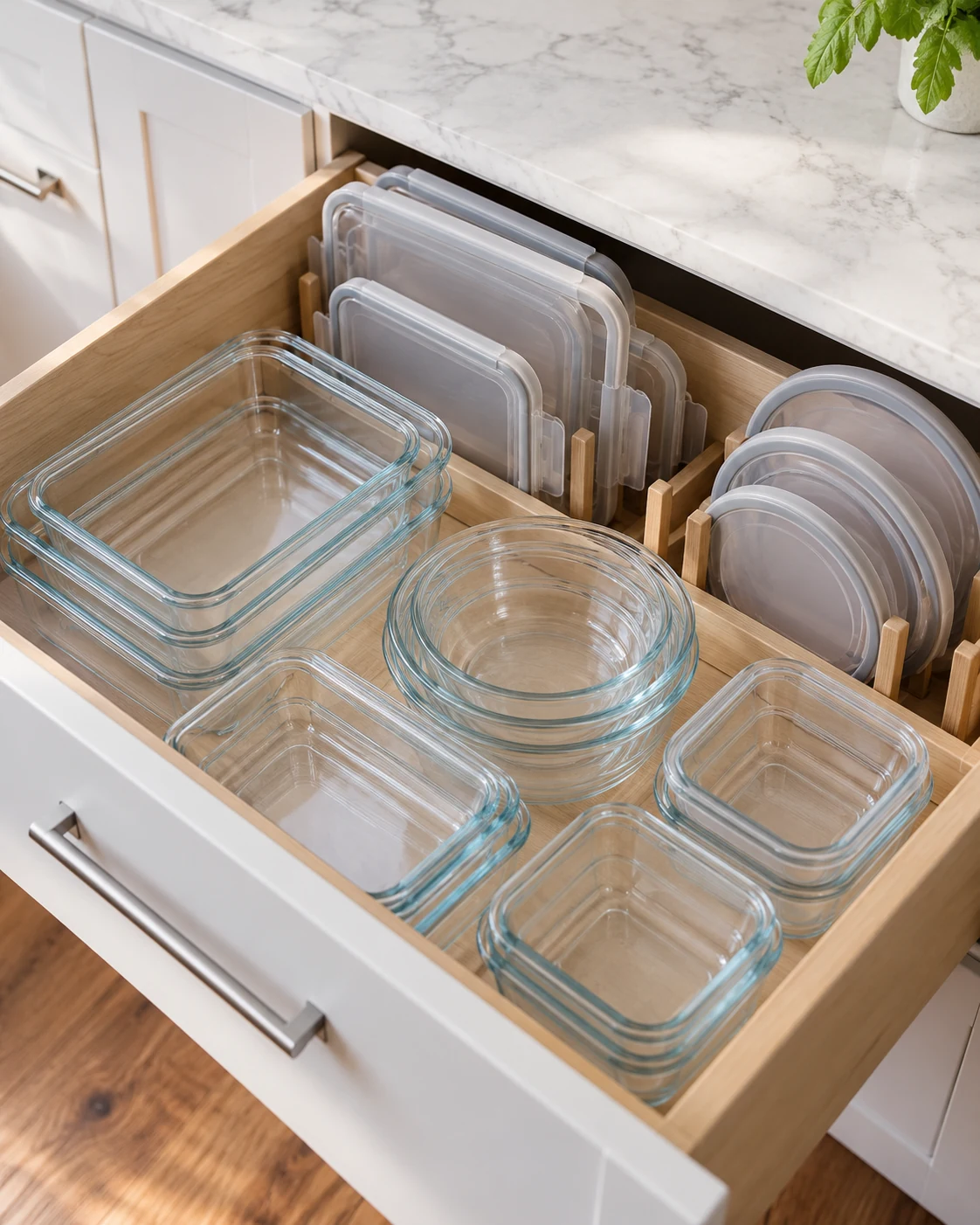
Group the containers and ordinary tools you use when packing the next day’s food. Check that lids and bases remain easy to match and remove. Keep empty containers together without nesting them so tightly that retrieval dismantles the drawer.
Comparable options, not the exact pictured items. Check the selected color, size and buying notes.
Materials, fit and differences from the concept
- Rubbermaid Brilliance 3.2-cup containers: Five 3.2-cup Tritan containers with matching lids. Check lid condition, fit and care directions. These are food containers, not an insulated cooler.
Use the actual sizes that suit your food and storage needs. A set containing several matching pieces isn’t automatically the right size for the available drawer. Our small pantry ideas consider a similar distinction between useful working stock and crowded backup supplies.
8. Reserve space for measuring tools
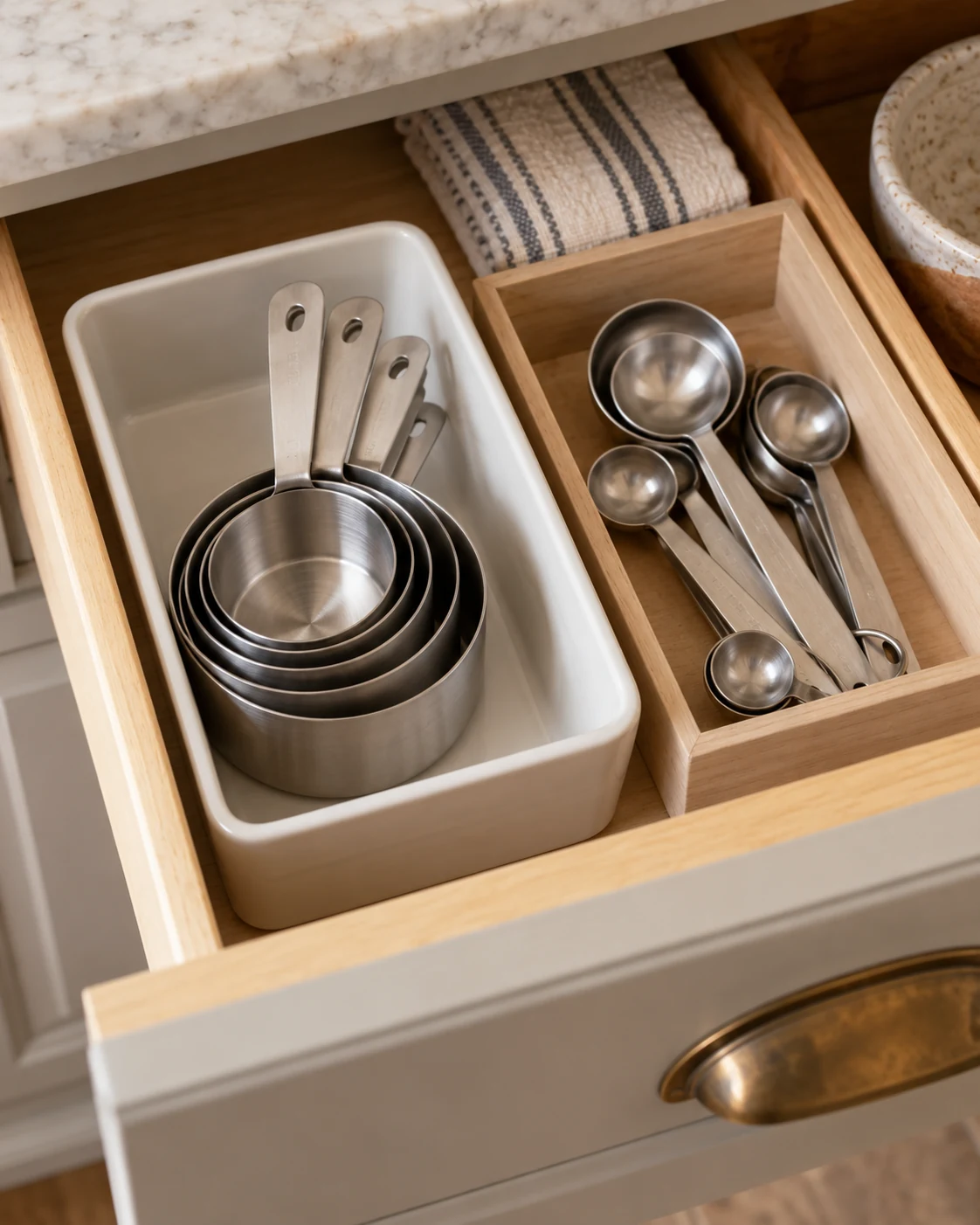
Keep measuring cups and spoons together when they’re normally used for the same task. Check the stack’s highest point beneath the drawer’s closing path. A nested group can rise higher than it looks when photographed from directly above.
Comparable options, not the exact pictured items. Check the selected color, size and buying notes.
Materials, fit and differences from the concept
- Natural bamboo adjustable drawer dividers: ROYAL CRAFT WOOD four-pack, natural bamboo, selected Large version. Title says 17–22 inches, while detailed text gives differing 17–21 or 21.5-inch ranges and depth values. Confirm exact size, depth and spring pressure with the seller before buying. Buyer reports differ on whether dividers shift during use. Separate straight dividers, not a complete fitted box system.
Keep the tools’ markings readable and their usual matching pieces nearby. Avoid making access depend on a perfect arrangement that nobody wants to rebuild after cooking. If the stack keeps catching, reduce the drawer’s contents or choose a more suitable storage place.
9. Give tea supplies a dry compartment
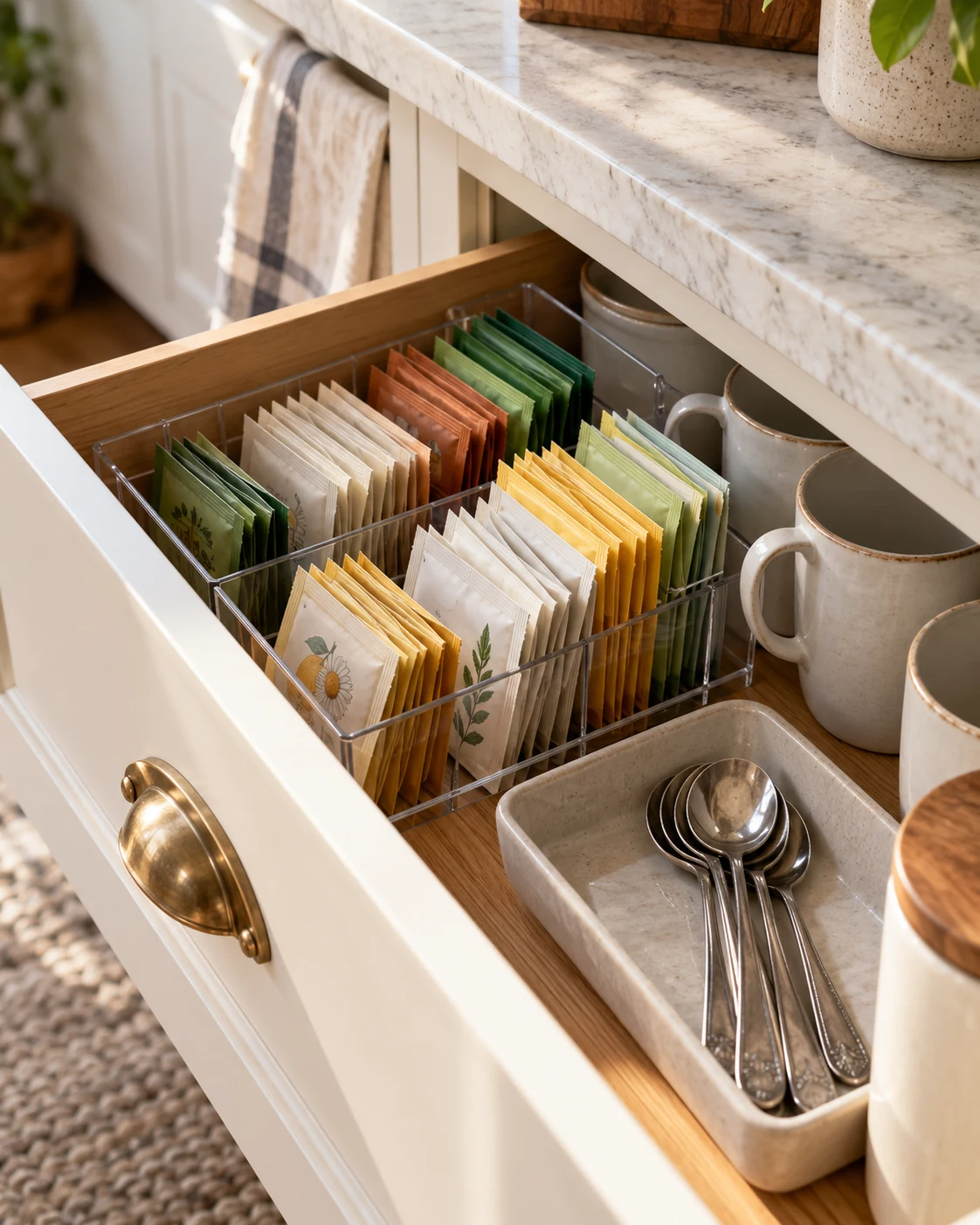
Original sealed tea packets can sit together when the drawer provides suitable dry storage. Keep identifying information available instead of decanting everything into a matching unmarked collection. Place teaspoons separately so reaching for one doesn’t disturb several packets.
Comparable options, not the exact pictured items. Check the selected color, size and buying notes.
Materials, fit and differences from the concept
- Natural bamboo expandable cutlery tray: ROYAL CRAFT WOOD natural bamboo nine-slot expandable tray. A bamboo alternative to the pictured white or clear trays. Merchant describes 17 x 13 to 17 x 19.6 inches with 1.9-inch slots; maker specs also list 17.5 x 13.5 x 2.5 inches. Confirm exact outside dimensions and closing clearance. Some buyers report the expandable parts move; no locking or universal-fit guarantee.
Check the location against nearby sources of heat, moisture or spills. Follow the food’s packaging guidance rather than assuming every drawer is suitable pantry space. The arrangement should make an ordinary drink easier to prepare without introducing another storage problem.
10. Use a separate place for sharp edges
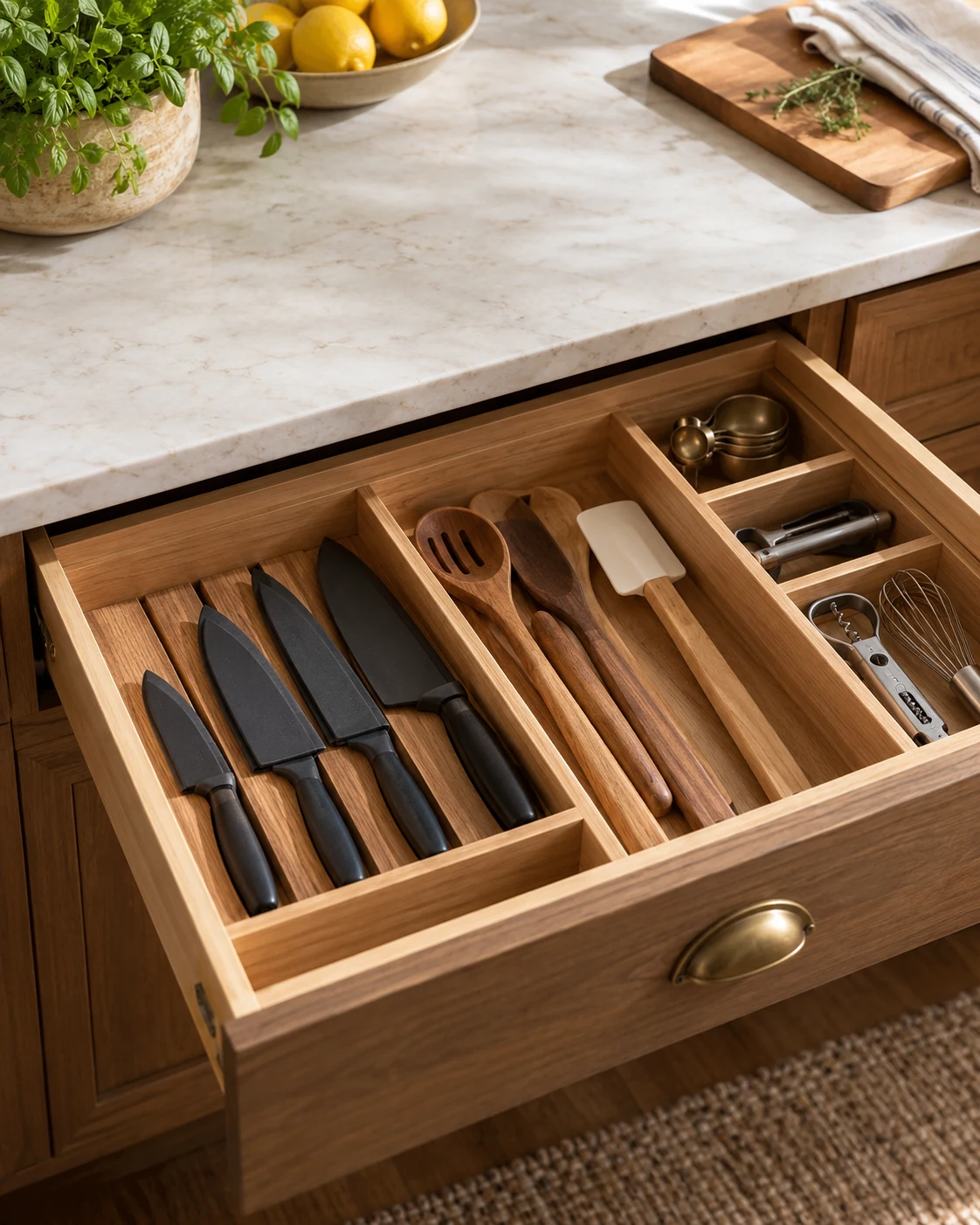
Use storage intended for the particular knives and tools you own. The protected-edge concept doesn’t establish that loose cardboard or an improvised sleeve is adequate. Keep sharp items identifiable and appropriately secured instead of mixing them beneath ordinary utensils.
Comparable options, not the exact pictured items. Check the selected color, size and buying notes.
Materials, fit and differences from the concept
- Stanley PowerLock tape measure: Sixteen-foot retractable tape measure. Check usable internal space, not just advertised external bag or cabinet dimensions.
Check household access needs before choosing the drawer or its storage method. A tidy arrangement isn’t the same as controlled access for children. Follow the relevant product instructions rather than copying a photograph’s visible arrangement as a safety assessment.
11. Leave a spare lane instead of filling it
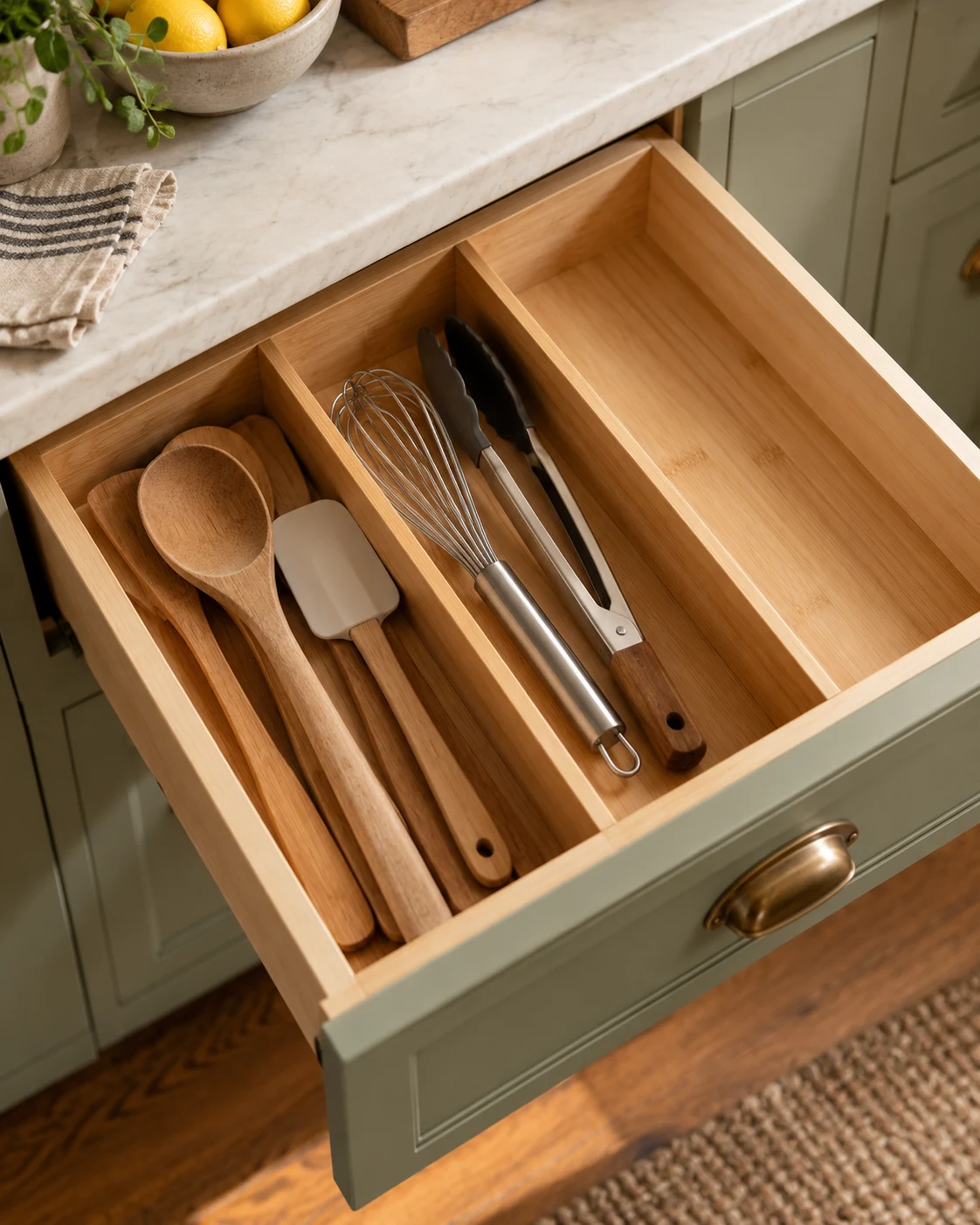
An empty lane can make existing tools easier to lift and return. You don’t need another gadget merely because the divider creates another compartment. Notice what the household repeatedly uses before deciding whether that spare space needs a permanent job.
Comparable options, not the exact pictured items. Check the selected color, size and buying notes.
Materials, fit and differences from the concept
- Natural bamboo adjustable drawer dividers: ROYAL CRAFT WOOD four-pack, natural bamboo, selected Large version. Title says 17–22 inches, while detailed text gives differing 17–21 or 21.5-inch ranges and depth values. Confirm exact size, depth and spring pressure with the seller before buying. Buyer reports differ on whether dividers shift during use. Separate straight dividers, not a complete fitted box system.
Keep occasional tools elsewhere when they crowd the everyday group without being used. Check the arrangement after a normal cooking session rather than only after sorting. A layout that works between cleanups is more useful than one that looks finished only once.
12. Check the drawer while closing it
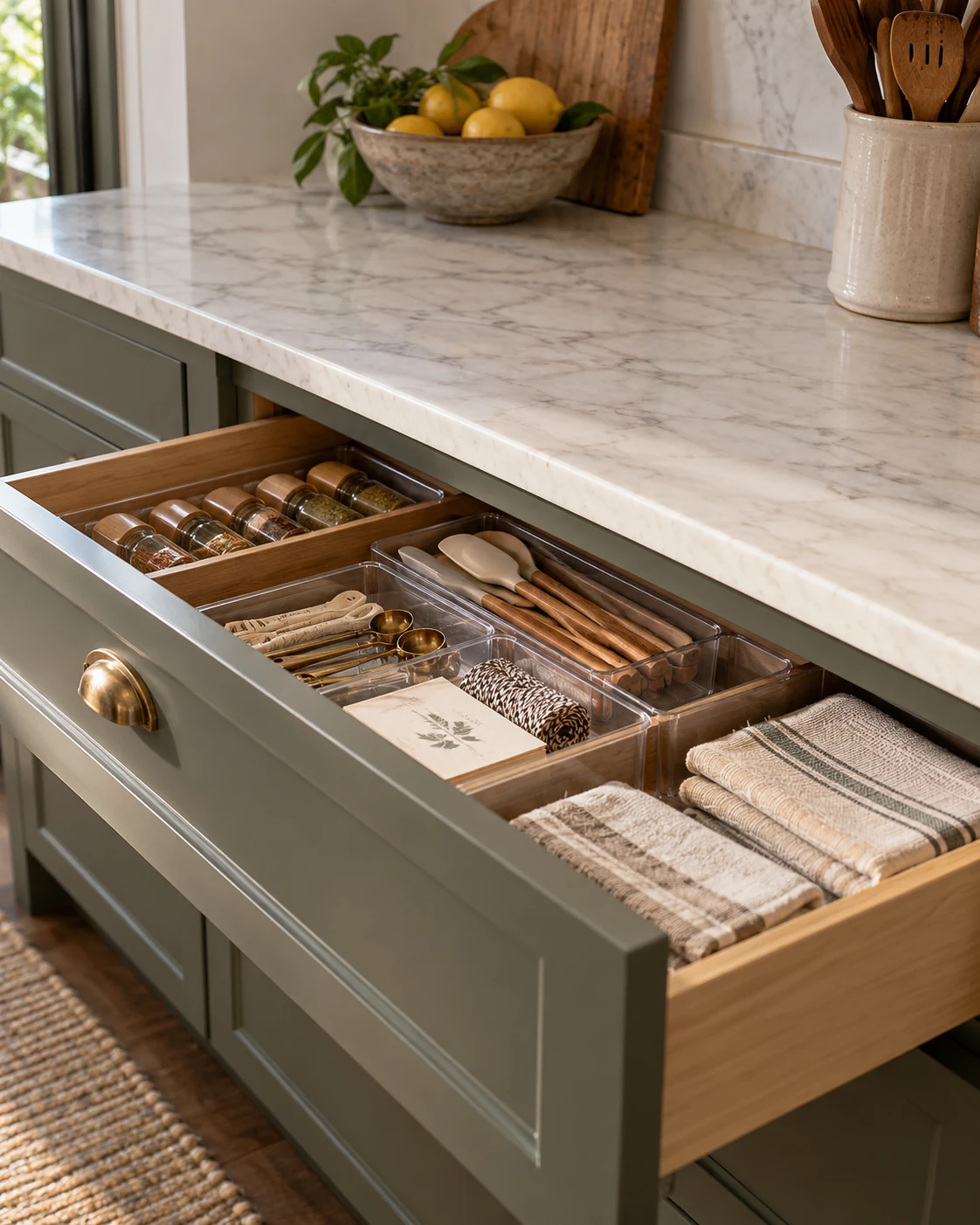
Load the proposed arrangement and close the drawer gently while watching for interference. Stop if something catches instead of forcing the front shut. Check the highest handle, the tray supports and any piece that shifts when the drawer moves.
Comparable options, not the exact pictured items. Check the selected color, size and buying notes.
Materials, fit and differences from the concept
- Stanley PowerLock tape measure: Sixteen-foot retractable tape measure. Check usable internal space, not just advertised external bag or cabinet dimensions.
- YouCopia DrawerFit sliding tray: YouCopia DrawerFit sliding tray. Amazon and current manufacturer pages list different heights and extension ranges. Confirm the exact version, supports and required clearance with the seller before buying; no guaranteed dimensions are claimed here.
Rearrange or remove the problem item, then repeat the ordinary opening and closing movement. Our under-sink organization ideas use the same principle around pipes and moving storage parts. Available floor area and usable moving clearance are different measurements.
Buy around the problem you actually found
Write down the required fit before comparing organizer photographs. Include usable dimensions, the support method and the tallest item the arrangement must hold. Keep that note beside the exact product version, particularly when a title and detailed measurements disagree.
Try suitable existing trays and dividers first when you already own them. Add a new piece only when it solves a remaining access or separation problem. You can keep a small kitchen drawer useful without buying a matching organizer for every category.
Visuals are original AI-generated editorial concepts, not photographs of actual products, tested projects or hosted events.


